

Nestled in the northern hills of County Louth (Lú), a landscape sacred to the god Lugh and legendary hero Cúchulainn, the hillfort of Faughart presents a compelling case study in the seamless fusion of pagan and Christian Ireland, the ancient site stands as a profound threshold in Ireland’s spiritual narrative. Here, the child Brigid was born into a world where the veneration of the pre-Christian goddess Brigid, a deity of poetry, healing, smithcraft, and cattle, would have been as tangible as the granite of the Ring of Gullion. The prevailing scholarly insight is that the historical saint did not merely share a name with this potent goddess but was profoundly influenced by her cult, effectively becoming its Christian vessel. Faughart, as a druidic centre of healing, learning, and sovereignty, was the ideal crucible for this spiritual transference.
This is a landscape already mythically charged, being the home territory of the legendary hero Cúchulainn. It is here, at this confluence of mythic history, pagan tradition and Christian innovation, that the child who would become Saint Brigid of Kildare drew her first breath. To understand her story is to examine the intricate tapestry of early medieval Ireland—a weave of oral lore and written word, centred on a strategic hillfort like Faughart.
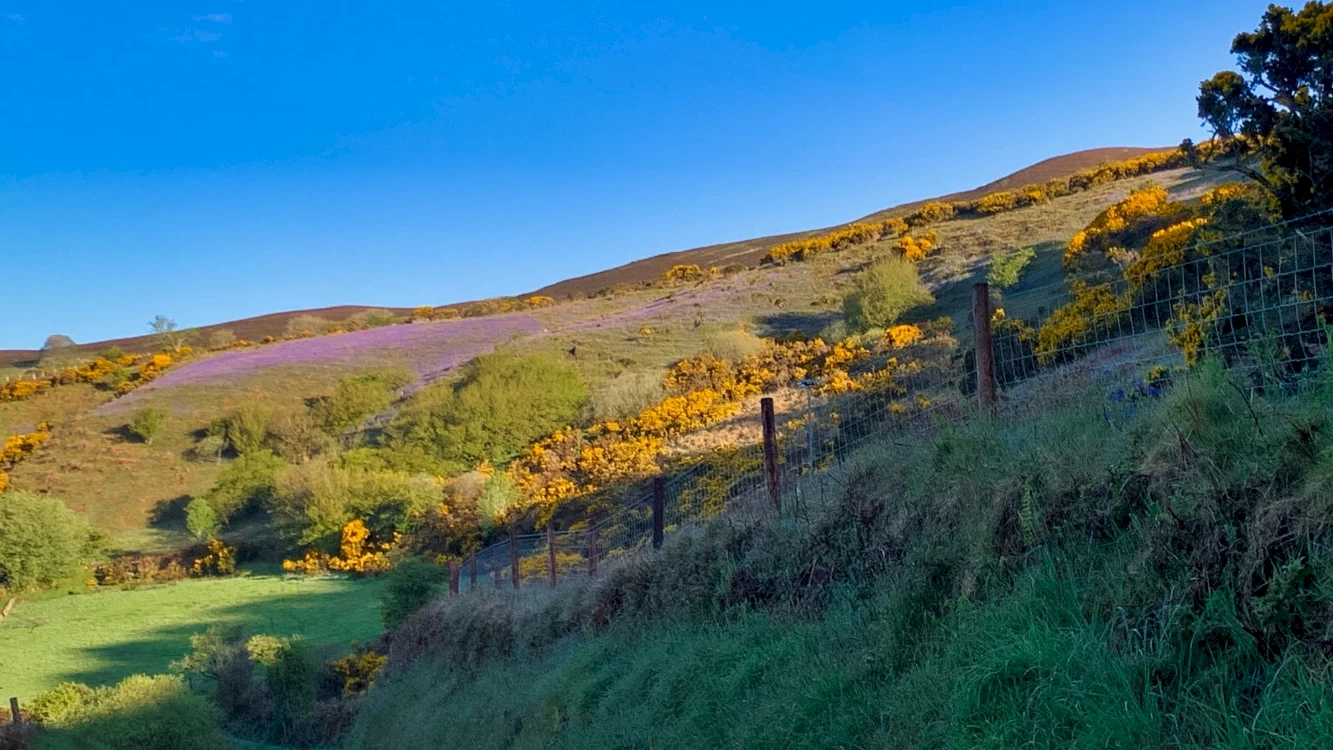
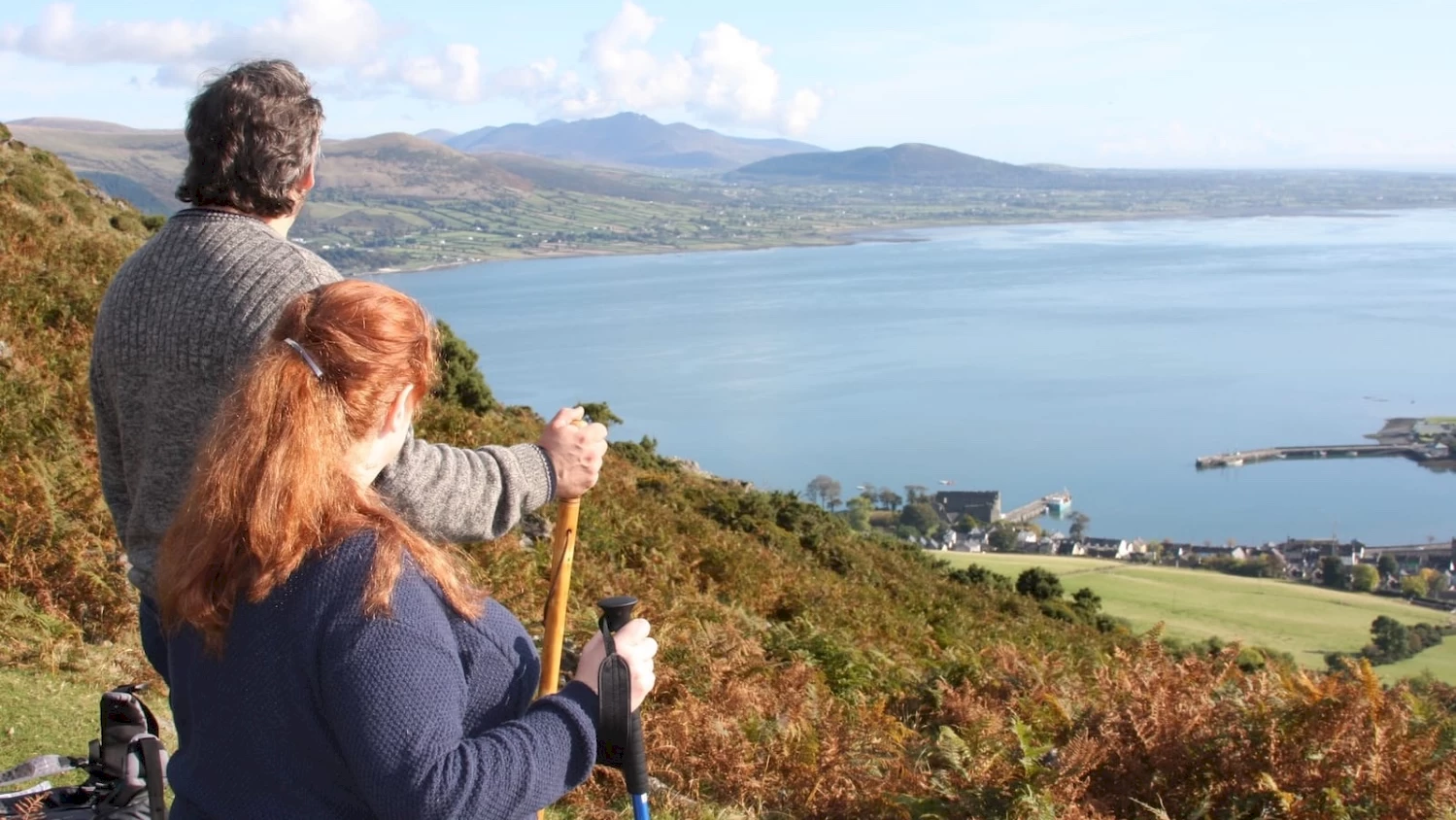
Faughart’s significance was magnified by its position on the Slí Míluachra, one of Ireland’s five great ancient roads. The site was not just a typical frontier outpost but a revered nodal point, a hillfort sanctuary on the ancient road, perched between the volcanic geology of the Ring of Gullion, the rich coastal plains of the Cooley Peninsula joining Muirhevna and the edges of the ancient Forest of the Fews.
This route was far more than a track; it was a conduit of culture, connecting the pagan ceremonial heart at Tara with the burgeoning Christian authority of Armagh. As a strategic point on this highway, Faughart was exposed to a constant flow of people, goods and crucially, ideas. Missionaries, traders, and travellers would have passed through, making it a cultural crossroads where the child Brigid’s world was inevitably broadened beyond the local.
Long before its Christian association, Faughart was a location of pre-Christian sanctity associated with healing, a legacy that seamlessly transitioned into the Christian era. Brigid’s enduring status as a patron of healers is thus firmly rooted in the practical therapeutics of her native place. This was a liminal zone, where boundaries between the human world and the Otherworld were considered thin, precisely the domain of druidic oversight.
According to tradition, Brigid was born circa 451/2 AD into a household that embodied Ireland’s spiritual transition. Her father, Dubhthach, was a pagan chieftain, whilst her mother, Broicsech, was a Christian. This mixed cultural lineage placed the young Brigid at the crossroads of belief. From her mother, she would have absorbed the nascent Christian ethics of compassion and charity. The spread of Christianity, advanced by figures like Saint Patrick, was thus a lived reality in her home, offering a transformative framework that directly shaped her legendary character and future ministry.
The elevated mound at the top of the hillfort itself would have served as a natural observatory. From this vantage point, the druids and a privileged fosterling like Brigid could track the movements of the sun, moon, and planets. This fosterage would have included instruction in native lore, meaning Brigid was likely educated in the very traditions her faith would later transform. Caesar noted that the druids were deeply concerned with “the stars and their movements”. Such observations were not abstract, they governed the lunar/solar calendar that regulated the ritual cycle, agricultural year and divinatory practices.
Whilst definitive archaeological proof remains elusive, the profile of Faughart as a prominent hillfort and a node on the Slí Míluachra makes it a highly plausible centre for druidic activity.
The druids were the intellectual, religious and legal elite throughout Celtic/Gaelic society, especially where such a high-status site would naturally support their community. Local folklore does suggest that the location of St. Brigid’s Shrine was once a druidic site and early hagiographies mention her fosterage in a druid’s household, fostering being a common practice for noble children. This fosterage included instruction in native lore, meaning Brigid was likely educated in the very traditions her faith would later transform. The druids were the custodians of a vast, exclusively oral tradition. Their education was rigorous and lengthy, specialising in several key areas encompassing law (Brehon law), history, genealogy, poetry, astronomy, natural philosophy, divination, and theology.
Classical sources, such as Julius Caesar, remark that the course of study could take up to twenty years to complete. This immense period was necessary to memorise the countless verses and legal tracts that constituted their knowledge, which was never committed to writing in the pre-Christian period. Training likely progressed through stages, perhaps from a novice to a bardic poet (fili), and finally to a fully-fledged druid (druí). This oral tradition was the bedrock of Gaelic society and intrinsically linked to secular power.
In early medieval Gaelic society, the roles of chieftain (rí) and druid (druí) were distinct but could coalesce within a single powerful lineage, especially in a place of such singular importance as Faughart.
If Dubhthach indeed held this dual role, it profoundly deepens our understanding of Brigid’s upbringing.
As chieftain of Faughart, Dubhthach would have been the secular guardian of its healing water, astronomical mound and ritual stones. In Celtic tradition, sacred kingship often involved a symbiotic relationship with the land’s fertility and spiritual well-being. Direct druidic knowledge of herb-lore, divinatory rites and the calendar governing festivals like Imbolc, would have been a potent source of his authority, enabling him to mediate between his people and the divine forces of the place.
As previously established, Faughart’s profile strongly suggests a druidic precinct. It is unlikely the resident chieftain would be separate from this core institution. He would more plausibly have been its chief patron and likely a leading member, having undergone an education in subjects such as Brehon law, history, and astronomy as would be expected of the elite.
The political connection between Celtic kings and druids was fundamental and symbiotic. Druids served as royal advisors, legitimisers of power, judges and sacred diplomats. A king’s strength was intertwined with his druids’ wisdom. Consequently, the conversion of a king, often influenced by figures like Brigid or Patrick, typically precipitated the conversion of his people and the gradual diminution of the druids’ temporal authority.
The feasibility that Brigid’s father, Dubhthach, was both chieftain and druid is critical to this synthesis. As a druid, he would have been the chief officiant in the rituals dedicated to the goddess, the keeper of her lore and the interpreter of her will. His custody of the sacred mound—a site for astronomical observation marking festivals like Imbolc, the goddess’s feast day—placed him at the heart of her calendrical worship. In this role, he wasn’t merely a pagan but the primary human link to a divine figure whose domains encompassed the entirety of civilized life. For the young Brigid, growing up and fostered in a druidic household, the goddess would have been the central archetype of female power and benevolence, her stories and attributes woven into daily life and seasonal ritual.
Her education would not have been solely from a foster-druid but potentially from her father himself. This places her at the very apex of native intellectual and spiritual tradition.
She would have witnessed firsthand the model of a leader who synthesised temporal power with spiritual responsibility, healing with governance and deep traditional learning with the pragmatic demands of rule. This becomes a direct prototype for her own future role as a Christian abbess—a female equivalent of a great monastic ruler, managing vast lands, offering spiritual sustenance and dispensing charity and healing.
The famous tales of Brigid’s defiance of her father (e.g., giving away his sword) take on a richer tension. It becomes more than just a generational or religious clash; it represents a direct challenge from the new Christian paradigm to the very heart of the old druidic-chieftain order he personified. Yet, significantly, the traditions do not portray him as a villain but often as a figure ultimately reconciled to her path, suggesting a complex negotiation between the old and new wisdom within one family
Whilst hagiographies emphasise Dubhthach’s pagan chieftaincy to heighten the drama of Brigid’s Christian conversion, the historical and landscape context of Faughart makes it not only feasible but compelling to consider him as a druid-chietain. This interpretation strengthens the thesis that Faughart was a unique crucible of tradition. The child Brigid thus stood to inherit not just a chieftain’s authority but the entirety of its accompanying sacred knowledge, the calendar of the skies, the properties of herbs and stones, the law of the land and the lore of the forest edge. Her genius, and her enduring legacy, may well lie in how she seamlessly translated this inherited, holistic sovereignty into the language of Christian monasticism, ensuring that the essential spirit of the place, like the rushes she wove, was not broken but reshaped into a new and enduring form.
This synthesis was possible precisely because of Brigid’s unique upbringing at Faughart. She didn’t convert from an abstract paganism; she was steeped in the specific, holistic tradition of a goddess whose functions were essential to society. Her Christian ministry did not reject these functions but redeemed and redirected them under a new theology. The Slí Míluachra facilitated this, bringing her the Christian framework that allowed for such a creative integration.
In early 5th-century Faughart, the goddess Brigid was not a forgotten relic but a vital spiritual force. As a daughter of the Dagda, she was the patroness of the filí (poets), a role deeply embedded in the druidic curriculum that included history, genealogy, and incantatory verse. She was a goddess of healing, associated with sacred wells and the therapeutic properties of herbs and stones, attributes physically manifested in Faughart’s healing stones and holy waters. Furthermore, as a goddess of smithcraft and cattle, she presided over the two pillars of the local economy: high-status metalworking and pastoral wealth. For the pre christian community at Faughart, invoking Brigid may have been considered essential for poetic inspiration, physical health and economic prosperity.
The genius of Saint Brigid’s legacy lies in how her life’s work can be seen as a conscious or subconscious Christianisation of the goddess’s domains. This was not a repudiation but a transformative translation.
The goddess, patron of poets, becomes the saint who inspires monks and scribes, preserving oral lore in manuscript. The monastic school of Kildare continued the druidic tradition of sacred learning.
The goddess of healing water becomes the saint associated with curative wells and the patroness of healers, her pre-Christian sites seamlessly rebranded but still visited for their draíocht.
The goddess of the forge and protector of herds became the saint patronising blacksmiths and dairy maids, her cross often hung in byres to protect livestock.
The goddess had a perpetual flame tended at Kildare; the saint’s monastic community famously maintained a sacred fire, a direct and potent symbol of continuity.
The humble rush cross, woven from a material used for thatch, bedding and light, thus becomes the perfect symbol. It is at once a Christian emblem and an artefact of everyday Celtic life. In it, we see the essence of the Faughart inheritance: the saint did not break with the old world but wove its strongest, most vital strands, the revered archetype of the goddess Brigid, into the fabric of the new, creating a resilient spiritual tapestry that has endured for millennia. The traditional St. Brigid’s cross, woven from rushes (Juncus spp.), is a symbol rooted deeply in the practical and spiritual life of the time. In choosing this ubiquitous material, the saint’s story anchors itself in the everyday. Moreover, the very act of weaving the cross can be seen as a mnemonic device, a tactile form of remembering and passing on the saint’s story and protection.
For a young girl of Brigid’s status, living in a druid’s household, the daily and seasonal rhythms of the sky would have been a fundamental part of her education. She would have learned to mark the solstices, equinoxes and the cross-quarter day of Imbolc—the festival that would later become inextricably linked with her own feast day.
Hillforts like Faughart were multifunctional centres of power, not just military strongholds. The typical industry at such sites in early medieval Ireland was diverse and often geared towards supporting an elite. Understanding such industry, also requires recognising the central pillar of the early medieval Irish economy, cattle. Wealth was measured in livestock, making their protection, management and production paramount. This context illuminates St. Brigid’s later patronage of cattle and dairy workers. The hillfort’s industry would have supported this bovine-centric world.
Metalworking: This was a primary high-status craft. Evidence from other Irish hillforts, shows intensive bronze and iron working for producing weapons, tools and fine jewellery.
Agricultural Processing: As centres of local authority, hillforts controlled surrounding farmlands. Activities would have included grain drying, milling and storing agricultural surplus.
Craft Production: This included woodworking, textile production (weaving and dyeing), and bone/antler working for everyday items.
Trade: The strategic location of hillforts on routeways like the Slí Míluachra made them natural hubs for exchanging locally produced goods for imported luxuries.
The arrival of Christianity instigated a profound shift from an exclusively oral tradition to a written one. While the druidic class guarded knowledge through memorisation, Christianity, however, was a religion of the book, requiring the development of reading and writing skills. The need to write down scriptures, liturgy, and saints’ lives led to the adaptation of the Latin alphabet to the Irish language. This gave birth to a magnificent written tradition, seen in works like the Book of Kildare, while the older oral tradition of stories, genealogies and laws began to be recorded by monastic scribes, preserving them in a new form.
Monastic foundations, like Brigid’s own great foundation at Kildare, became engines of literacy. In a pivotal act of cultural preservation, the newly literate monastic scribes began to commit the ancient oral histories, genealogies and laws to vellum, saving them from oblivion.
Whilst definitive archaeological proof remains elusive, other than some nearby motorway construction excavations, the sections of surviving rings around the hill add to the profile of Faughart as a prominent hillfort, the stream and healing stones confirm it as a renown centre for healing and its location on the Slí Míluachra, all make it a highly plausible centre for druidic activity.
In summary, Faughart stands as a microcosm of early medieval Ireland’s profound transformation. A place named for a god (Lugh) and famed for a hero (Cúchulainn) became the nurturing ground for a saint. The child Brigid, nurtured at this crossroads of ancient routes, mythic history and older beliefs, absorbed both a rich native heritage, of druidic learning, astronomical observation, a cattle-based economy with a deep tradition of healing with water, stones and herbs, absorbed into a revolutionary Christian faith. Her enduring legacy, symbolised by the humble rush cross, perfectly embodies the moment Ireland’s deep traditions were woven, not discarded, into the new faith, creating a unique cultural tapestry where the old ways illuminated the new.
Therefore, to ask if the saint was influenced by the goddess is to glimpse the very mechanism of Ireland’s conversion. The historical Brigid of Kildare was likely a figure of such formidable character and spiritual insight that she naturally embodied the qualities her culture already revered in the divine. The later hagiographies, written by monastic scribes inheriting the druidic penchant for memorised lore, formalised this synthesis, mapping the saint’s miracles onto the goddess’s domains.
Perhaps today, St Brigid’s enduring legacy is, in essence, still the story of Irish spirituality itself. Her significance exists in a liminal space, much like the ancient Shrine, between the declining institution of organised Christianity and a persistent, personal hunger for the sacred. While traditional church attendance recedes, the figure of St Brigid, has been powerfully reclaimed by the feminist movement, not just because of the result of lost faith in traditional outlets but perhaps as a direct response to that loss.
St Brigid is associated with a more accessible, personal and nature connected form of spirituality. She is a historical figure, a mythical goddess, a feminist icon and a source of personal intercession. At her Shrine, a more complex, living faith is demonstrated daily. Regular arrivals every few minutes, engage in a personal continuum of faith that would be recognisable at any time since St Brigid was a youngster in that place. In an age of institutional transition, she endures not as a symbol of anything lost but as a timeless archetype of compassion and strength.
Crossing boundaries, borderlines between a deep past and a searching present where the simple act of weaving a rush cross or touching a healing stone continues to weave the tapestry of faith.